Oops! Something went wrong while submitting the form.
Oops! Something went wrong while submitting the form.
.png)

.png)
Accessory Dwelling Units and Short-Term Rentals in 2026: What Counts as a Separate Unit
Building an accessory dwelling unit and listing it on Airbnb sounds simple until you check your city's actual zoning code. Some cities treat a backyard cottage or converted garage as a straightforward extension of your home. Others flatly prohibit short-term rentals in any ADU, no matter who owns it or lives on-site. Since ADU construction has expanded fast over the past few years, this is one of the areas where hosts and portfolio managers most often assume a rule that doesn't actually apply to their city.
There is no single national standard here. Cities have taken genuinely different positions on whether an ADU can be a short-term rental, and the differences fall into three general patterns.
Some cities ban it outright. In Redwood City, California, short-term rentals of new ADUs and Junior ADUs are not permitted under Article 37 of the Zoning Ordinance. San Francisco goes further: ADUs are categorically ineligible for the city's Short-Term Rental program, regardless of occupancy. San Ramon, California disqualifies any property with a JADU or ADU from STR registration entirely, treating short-term rentals as a separate, incompatible use under its zoning ordinance. Colorado Springs, under its 2025 ADU Ordinance (Ord. #25-45), is explicit that a structure cannot be dually used as an ADU and a short-term rental. Asbury Park, New Jersey requires that one unit on any ADU property be the owner's primary residence and prohibits short-term or seasonal rentals on the property entirely, permitting only year-long leases.
Some cities allow it, but only with owner-occupancy. Cincinnati permits an ADU to operate as a short-term rental as long as the property owner or a responsible person occupies one of the dwelling units on the property and the unit is registered under the city's short-term rental regulations, Chapter 856 of the Municipal Code. Walnut Creek, California generally bars short-term rentals in ADUs, with an exception for units permitted before January 1, 2020, and requires that rentals otherwise run 31 days or longer. Interestingly, as of January 2024, California state law removed the owner-occupancy mandate for ADUs generally, though that change doesn't override a city's separate short-term rental restrictions, and Junior ADUs still carry their own owner-occupancy requirement.
A smaller group of cities have built specific accessory short-term rental categories. Portland, Oregon allows ADUs to operate as "Type A" accessory short-term rentals under Chapter 33.207 of its Zoning Code, permitting up to two bedrooms rented for stays under 30 consecutive days, provided the host secures the correct permitting. A separate "Type B" category carries its own rules under a different subsection. Notably, if a Portland ADU received a System Development Charge waiver during construction, the property is barred from short-term rentals of any kind for 10 years.
Note on gaps: application fees, exact permit timelines, and enforcement penalties for ADU short-term rentals vary by city and were confirmed only for the jurisdictions cited above. If your ADU sits somewhere not listed here, the pattern to check is whether your city treats the ADU as automatically excluded from STR use, conditionally allowed with occupancy, or explicitly permitted under its own accessory-use category.
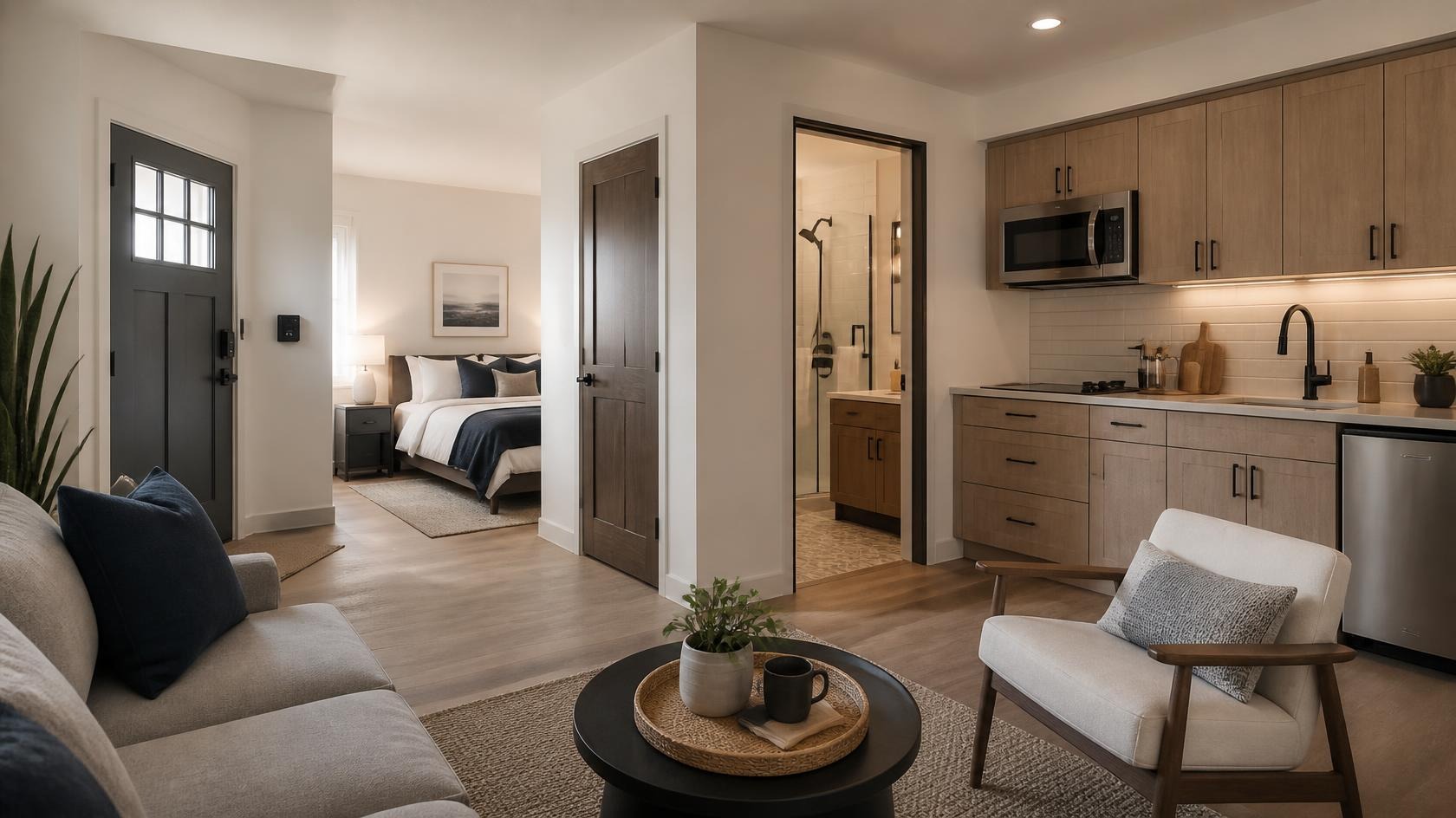
If your city falls into the outright-ban camp, San Francisco, Redwood City, San Ramon, Colorado Springs, or Asbury Park among them, an ADU cannot legally become a nightly rental regardless of how it's configured, whether you live on-site, or what your main house's STR permit allows. Attempting it anyway risks the property being found in violation during a permit audit or neighbor complaint, since these prohibitions apply at the zoning level, not just the licensing level.
If your city allows it conditionally, like Cincinnati or pre-2020 Walnut Creek units, the owner-occupancy requirement is the load-bearing detail. A detached ADU rented out while the owner lives offsite, or while the main house sits vacant or under separate management, is the exact configuration these rules are designed to catch.
If you're in a city with a defined accessory STR category, like Portland's Type A and B classifications, the ADU can be a legitimate, permitted listing, but it comes with its own bedroom counts, stay-length limits, and permitting steps separate from whatever covers your main home. Skipping that separate permit is one of the more common compliance gaps portfolio managers find during an audit.
For portfolio managers, the practical takeaway is that ADU-eligible STR use has to be checked structure by structure and city by city. A model that works cleanly in Portland can be a straightforward violation in San Francisco or Redwood City, even on architecturally identical properties.
Whether an ADU can legally operate as a short-term rental depends entirely on which city it sits in, and the range runs from an outright ban to a fully defined accessory-use permit category with its own rules. Confirming which camp your city falls into before listing a backyard cottage or converted garage is a lot less costly than finding out through a zoning complaint.
Not sure what this means for your property? Get your free compliance report at lodgecompliance.com

.jpg)
.jpg)
.jpg)
.jpg)


.png)

