Oops! Something went wrong while submitting the form.
Oops! Something went wrong while submitting the form.
.png)

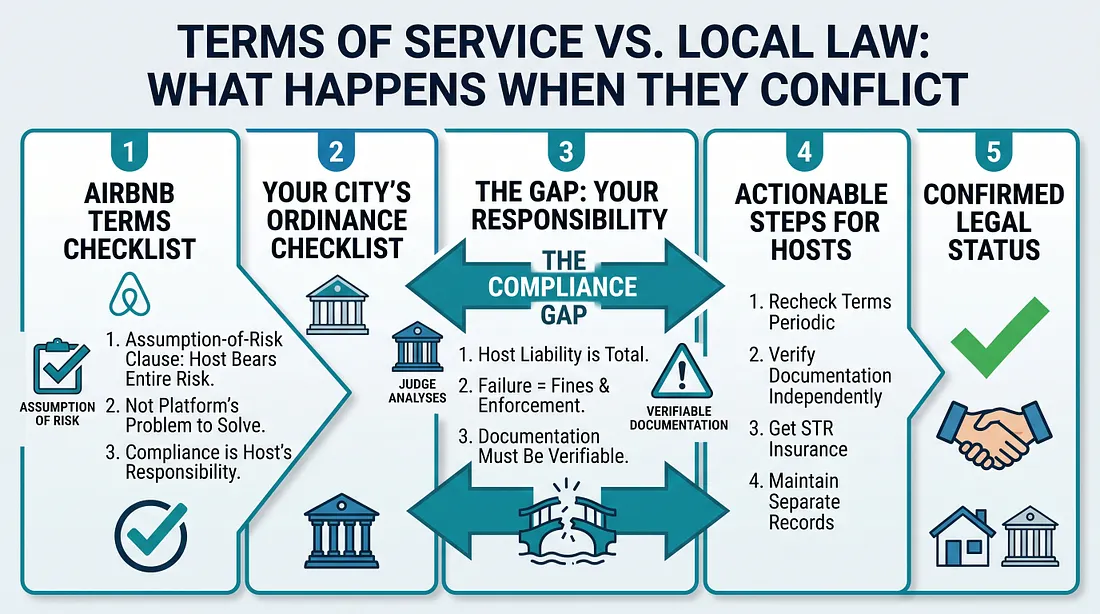
Airbnb’s terms of service and your city’s short-term rental ordinance are both documents you’re bound by, but they weren’t written to agree with each other, and when they conflict, only one of them is going to protect you. It isn’t the one you signed by clicking “I agree.”
Airbnb’s terms explicitly place the burden of legal compliance on the host, not the platform. The platform requires you to understand and follow local law, but its own terms also include an assumption-of-risk clause that puts the consequences of getting it wrong squarely on you. Meanwhile, cities increasingly hold platforms accountable too, but that accountability runs alongside host liability, not instead of it. In practice, that means a listing can be fully “compliant” with Airbnb’s platform rules while still being illegal under your city’s ordinance, and Airbnb’s terms make clear that’s not their problem to solve.
Airbnb’s Additional Terms for Hosts state plainly that hosts are responsible for understanding and complying with all applicable laws, obtaining and maintaining required licenses and permits, and notifying Airbnb if they fall out of compliance. That sounds like an active compliance partnership, but the platform’s broader Terms of Service go further in the other direction: Airbnb states it does not control the conduct of hosts and guests, has the right but not the obligation to monitor platform use, and requires hosts to acknowledge they’ve assumed the entire risk of offering their listing and had the opportunity to investigate applicable laws themselves. Read together, the message is consistent: Airbnb will ask you to comply, but it isn’t taking on the job of confirming that you have.
This gap became visible in concrete terms with New York City’s Local Law 18. The law requires hosts to register before listing and bars platforms from processing payments for unregistered units, and it backs that up with fines up to $5,000 for non-compliant hosts and $1,500 for platforms that process bookings anyway. Airbnb’s own terms, which include that assumption-of-risk language and disclaim any obligation to verify host information, sit in direct tension with a law built specifically to make platforms respond to unregistered listings. Airbnb challenged the law in court and lost, the city’s registration requirement stood, but the platform’s underlying terms toward hosts didn’t change as a result. The legal fight over the platform’s obligations to the city doesn’t rewrite what the platform’s terms say about its obligations to you.
San Francisco shows the same dynamic from an earlier round: its ordinance makes it a misdemeanor, punishable by a fine up to $1,000 and up to six months imprisonment, to collect a booking fee for an unregistered unit, a rule aimed squarely at platforms, not hosts directly. Airbnb fought this one too, on free-speech and Communications Decency Act grounds, and lost on appeal. Cities are increasingly willing and able to make platforms share in enforcement consequences. But every one of these fights has been about platform liability to the city, none of them created a new obligation for Airbnb to protect an individual host from their own noncompliance.
The practical result shows up most clearly with AirCover, Airbnb’s host protection program. It is not a substitute for landlord or short-term rental insurance, and it will not cover you if your listing is operating in violation of local licensing, zoning, or tax rules. A platform-level fight over registration enforcement in a city like New York or San Francisco has no bearing on whether AirCover pays out on an individual claim that determination still comes back to whether the host, specifically, was in compliance.
The platform sets the marketplace rules; the city sets the actual law, and when they disagree, you’re the one who has to satisfy both, because neither one is going to cover the gap for you. Lodge Compliance handles the part that has nothing to do with Airbnb’s terms at all: the actual local registrations, permits, and filings your property needs to be legally compliant, independent of what the platform requires or protects. Get a free property compliance report at lodgecompliance.com to understand the city laws that applies to your property today.
Airbnb wrote its terms to protect Airbnb. Your city wrote its ordinance to protect the city. Reading both carefully is the only way to make sure someone’s protecting you.

.jpg)
.jpg)
.jpg)
.jpg)


.png)

