Oops! Something went wrong while submitting the form.
Oops! Something went wrong while submitting the form.
.png)


Your short term rental license expired. Can you keep hosting while you renew it? Maybe. Maybe not. And that is the problem.
There is no universal rule for what happens when an STR license expires. Some cities give you a short period to submit a late renewal. Some have a specific renewal window that opens only once or twice a year. Others treat the expiration much more seriously and require you to apply for a new permit. In some places, losing an existing permit can be especially painful because new STR permits are limited, subject to a lottery, or temporarily unavailable altogether.
So if you are asking “what happens if my STR license expires?”, do not assume the answer is simply that you pay a late fee and move on. The rules in your city could determine whether you are dealing with a simple paperwork problem or a much bigger business problem.
It is easy to think of an STR permit the same way you think about a driver’s license. You miss the renewal date, pay what you owe, and get back on the road. Short term rental regulations do not always work that way. Some jurisdictions give hosts a grace period. Others give existing permit holders a specific renewal period and close the application window once that period ends. Once that happens, you may lose the benefit of being an existing permit holder.
That can matter a lot in a city where new STR permits are capped, limited by zoning, issued through a lottery, or not currently being accepted.
Here are a few examples.
Annapolis is a good example of why STR owners should take their renewal seriously. The City has established a 12 month moratorium on issuing new non owner occupied short term rental licenses. That creates an important distinction between an owner who already has a valid license and someone trying to obtain a new one. If you already operate legally, keeping your existing license in good standing becomes extremely important. If you lose that license and new non owner occupied applications are not being accepted during the moratorium, you may not simply be able to submit a new application the next day.
Annapolis also requires STR licenses to be renewed annually. For an STR owner, that means the renewal deadline is not something to treat as a routine administrative task. Your existing license may be much easier to preserve than it is to replace.
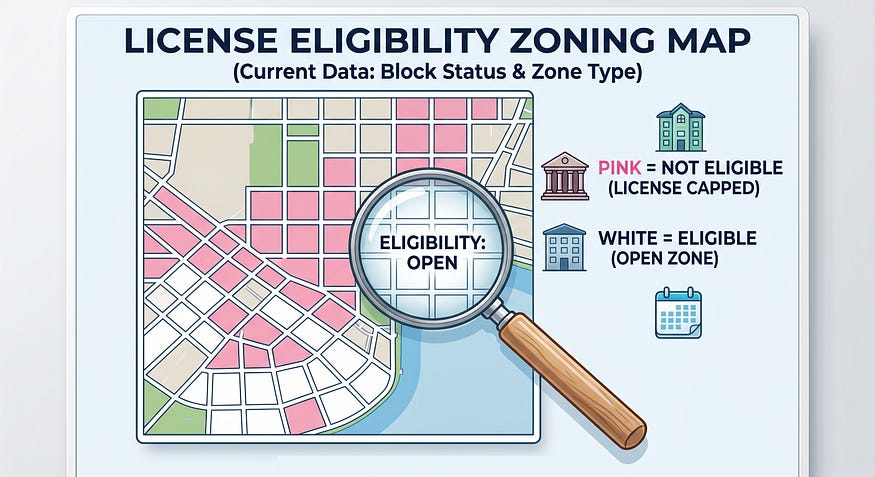
New Orleans is one of the clearest examples of why STR owners need to know their jurisdiction’s actual renewal calendar. The city uses specific application and renewal periods rather than leaving the process open indefinitely. For 2026, NSTR license holders had a designated renewal period, and the city warned that owners who failed to renew on time could lose their NSTR license and would have to reapply through the lottery process if their property’s square was available.
The city is continuing to use scheduled lottery periods in 2026. The next NSTR lottery is scheduled for October 6, 2026, with applications accepted from September 16 through September 22.
That is very different from simply paying a late renewal fee. Once you miss the renewal window, you may no longer have an automatic path to keep the permit you already had. Your property could have to go back through the lottery process instead.
For an owner who has already been operating legally, that can make missing a renewal deadline much more serious than it initially appears. This is why STR owners in cities with renewal windows should not wait until the last few days to start the process.
Keystone provides another example of a jurisdiction that uses a defined renewal period. For the 2026 to 2027 licensing cycle, the town’s STR renewal application period runs from September 1 through September 30, 2026. The town also says registered STR license holders will receive an email with instructions when the renewal period opens.
That may sound simple, but it creates an important responsibility for the owner. Getting a renewal email does not mean you can wait until whenever you have time. If the renewal period closes, the opportunity to renew may close with it. This is why hosts should know both their license expiration date and their renewal application window. They are not always the same thing.
Santa Rosa gives hosts more breathing room than some jurisdictions. The city sends a courtesy reminder approximately 60 days before the STR permit expires. Renewal applications can be submitted during the 60 days before expiration and up to 30 days after the permit expires. There is an important benefit to filing within that window.
If the renewal application is submitted on time, including within the permitted 30 day period after expiration, the expiration can be stayed while the city reviews the renewal. The host may continue renting while the renewal application is being processed.
But miss that entire window and the situation changes. The city requires the host to stop short term rental activity and obtain a new STR permit. For non hosted STR permit holders, that could be particularly serious because Santa Rosa is not accepting new non hosted STR permit applications.
So even a city with a grace period can have serious consequences if you miss the final deadline.
St. Tammany Parish takes an interesting approach. The parish requires the Department of Planning and Development to provide written renewal notice at least 60 days before the STR permit expires.
But that reminder does not extend the permit indefinitely. The parish rules state that failing to renew before the expiration date makes the permit immediately invalid. There is also a specific protection for operators who timely file their renewal application and satisfy the required conditions.
This is a good example of why receiving a renewal notice is not the same thing as receiving an extension. The notice is a reminder. The deadline is still the deadline.
Colorado Springs takes a much stricter approach. There is no general grace period that allows a host to casually renew after the deadline. For non owner occupied STRs in particular, missing the renewal deadline can put an established permit at risk. This is important for investors because non owner occupied STR permits can be much harder to replace than they were to obtain originally.
If the local rules have changed since the original permit was issued, a new application may also have to satisfy requirements that did not exist when the property first qualified.
Bend provides another important lesson because STR operators have separate approvals for land use and annual operation. The city requires both a Land Use Permit and an annual Operating License.
That means a missed renewal can create consequences beyond simply losing the current year’s operating license. If the required renewal is not completed within the applicable timeframe, the underlying land use approval can be affected.
For an owner who originally qualified under older rules, having to start over can be a major problem if the current requirements are more restrictive. This is one of the most important questions to ask when your STR permit expires: Are you losing only the license, or are you losing the approval that made the property eligible for STR use in the first place?
The rules are different, but there is a pattern. Your risk depends on what your jurisdiction does after the deadline passes. There are roughly four situations you may encounter.
2. A renewal window: The city only accepts renewals during a specific period.
3. A new application requirement: Once the renewal period closes, you have to apply again.
4. Loss of an existing entitlement: Missing the deadline can cause you to lose a permit or approval that may be difficult or impossible to replace.

.jpg)
.jpg)
.jpg)
.jpg)


.png)

