Oops! Something went wrong while submitting the form.
Oops! Something went wrong while submitting the form.
.png)

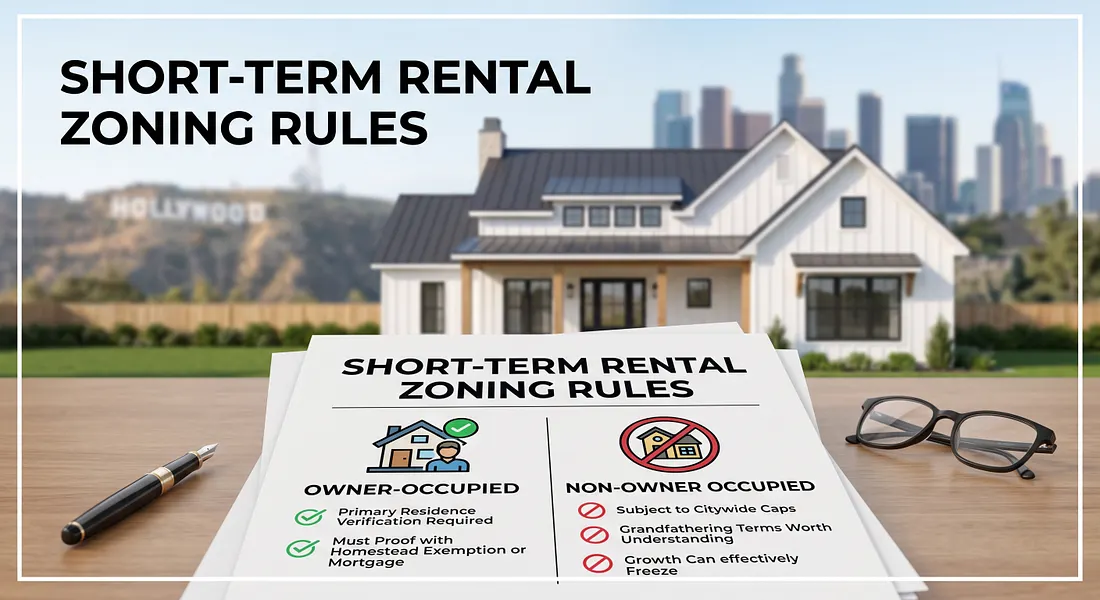
If you are thinking about buying a property to use as an Airbnb or another type of short term rental, there is one question you should answer before you get too far into the process:
Are you going to live there?
It may seem like a simple question, but in many cities, the answer can determine whether you can legally operate a short term rental at all. More jurisdictions are separating owner occupied STRs from non owner occupied STRs and giving each one a different set of zoning rules. An owner occupied STR is generally a property where the owner lives as a primary resident and rents out part or all of the home for short stays. A non-owner occupied STR is usually an investment property. The owner does not live there, and the property is operated primarily as a vacation rental.
That distinction matters because a city may allow an owner occupied Airbnb in a residential neighborhood while restricting or completely prohibiting a non-owner occupied vacation rental in that same area. So if you are looking at a property as an STR investment, checking whether short term rentals are allowed is only the beginning. You also need to find out which type of STR the local rules allow.
Why do cities care whether the owner actually lives at the property? A big part of it comes down to how the city views the property. When the owner lives there, the property is still primarily functioning as a residence. There is someone living on site who is directly responsible for the home, the guests, and what happens at the property. A non-owner occupied rental is different. If guests are constantly coming and going and no one actually lives there, the property can start to function more like a small lodging business than a traditional home.That is one reason some cities are more comfortable allowing owner occupied short term rentals in residential areas while putting stricter limits on investment properties.
And these restrictions are not the same everywhere.
Colorado Springs puts a specific number on owner occupancy. To qualify as owner occupied, the owner must physically live at the property for at least 185 days each year. Owner occupied STRs can be allowed in lawful dwelling units where residential use is permitted.
Non owner occupied STRs face much stricter rules. New permit applications submitted after December 26, 2019 are not permitted in the city’s single family zoning districts. In other areas where they are allowed, a non owner occupied STR generally must be at least 500 feet from another non owner occupied STR. So two homes in the same city can have completely different STR options simply because one is the owner’s primary residence and the other is an investment property.
Nashville also makes a clear distinction between owner occupied and non owner occupied short term rentals. Owner occupied STRs are generally allowed in zoning districts where residential use is permitted, except for areas specifically designated as having no short term rentals. Non owner occupied STRs are more limited and can only operate in specific areas permitted under the Metro Code.There is another issue investors need to pay attention to: grandfathered permits.
Tennessee’s Short Term Rental Unit Act provides protections for certain existing STR permits when local rules become more restrictive. However, those protections are tied to the original permit and the circumstances under which it was issued.In other words, an investor should never assume that buying a property with an existing STR permit automatically means they will receive the same rights as the previous owner.
Charleston takes a different approach by using specific geographic areas to determine where short term rentals can operate. Properties located within the city’s Short Term Rental Overlay Zone may qualify for STR permits regardless of whether they are owner occupied. The rules are much different in the Old and Historic District. In that area, short term rentals are limited to owner occupied properties. For an investor who does not live at the property, that can mean there is no path to obtaining a legal STR permit there. This is a good example of why looking at the general zoning map is not enough. A property’s location within an overlay district can completely change the rules that apply to it.
Los Angeles County takes a much stricter approach to short term rental eligibility. The county’s rules generally limit STR activity to a host’s primary residence. That means a second home or investment property where the owner does not live will not qualify simply because short term rentals are allowed in the area. The rules also restrict STR use of certain properties, including accessory dwelling units and rent restricted units. For investors, this is an important point. A property may look perfect for an Airbnb investment, but that does not mean it is legally eligible for short term rental use.
Woodstock shows that the difference between owner occupied and non owner occupied STRs is not always about whether you can operate. Sometimes it is about how much you can operate. Owner occupied short term rentals have more flexibility when it comes to bedrooms and guests. Non owner occupied STRs are instead subject to limits on the number of days they can be rented each year, along with additional restrictions on weekend rentals. The result is a system that allows some investment property activity without allowing a non-owner occupied property to operate like a full time vacation rental.
If you are buying a property specifically because you believe it can become an Airbnb or vacation rental, the owner occupancy question should be answered before you close. Do not rely on the fact that other short term rentals are operating nearby. Do not assume that because a property is zoned residential, an STR is automatically allowed. And do not assume that an existing permit will come with the property when you purchase it.
Before moving forward, find out:
This is especially important for investors. A property that works perfectly as an owner occupied Airbnb may not work at all as a non owner occupied vacation rental. That difference can completely change the numbers behind an investment.

One of the easiest mistakes to make is assuming that if short term rentals are allowed in a particular neighborhood, they are allowed for everyone. That is not necessarily the case. As Colorado Springs and Nashville demonstrate, owner occupied and non owner occupied STRs can have very different zoning requirements.
The phrase sounds straightforward, but the definition can vary from one jurisdiction to another. Some cities require the owner to live at the property for a certain number of days each year. Others focus on whether the property is the owner’s primary residence. Colorado Springs, for example, uses a 185 day requirement. Do not assume you meet the definition without checking the actual local rule.
This can be a particularly expensive assumption for an investor. A property may have been legally operated as a short term rental for years, but that does not necessarily mean the permit transfers to the next owner. If you are buying an existing STR, find out exactly what happens to the permit when ownership changes before you make the purchase.
The property’s base zoning is important, but it may not tell you everything. Overlay districts, special zoning areas, historic districts, and other local restrictions can create additional STR requirements.
Charleston is a good example of how a property’s exact location can make a major difference.
This is probably the mistake that can cost an investor the most. If your investment depends on short term rental income, verify the property’s STR eligibility before you buy it. A beautiful property in a desirable location does not automatically make a good Airbnb investment. If the local rules do not allow the type of STR you intend to operate, the investment may not work the way you expected.
There is no single definition used across the country. Some jurisdictions require the owner to physically live at the property for a certain number of days each year. Others require the property to be the owner’s primary residence. The only safe approach is to check the specific definition used by your city or county.
Sometimes, but not everywhere. Some jurisdictions allow non owner occupied STRs in certain residential areas. Others limit them to specific zoning districts, impose spacing requirements, or prohibit new permits entirely. Always check the zoning rules that apply to the specific property.
Not necessarily. Some permits or grandfathered rights may be tied to the original owner, the property, or specific conditions. A change in ownership can affect those rights, so investors should verify the transfer rules before purchasing a property.
Not necessarily. Owner occupied properties may have broader zoning eligibility, but they can still be subject to limits on bedrooms, guests, rental days, or other operating requirements. What matters is understanding which rules apply to your specific property and your intended use.
The words owner occupied and non owner occupied may sound like a small distinction, but in short term rental regulations, they can make a huge difference. Before you assume a property qualifies for Airbnb, Vrbo, or another vacation rental platform, find out exactly how your jurisdiction treats the type of STR you plan to operate. Check the zoning district. Check the STR regulations. Look for overlay districts. Confirm the owner occupancy requirements. And if the property already has an STR permit, find out whether that permit can actually transfer to you.
Do not buy first and discover the rules later. If the property’s ability to operate as a short term rental is part of your investment plan, verify that eligibility before you commit.
Know the zoning before you buy. Know the rules before you list. Need help with understanding the compliance rules that apply to an address before closing the deal? Get a property report today at lodgecompliance.com to make a solid decision.

.jpg)
.jpg)
.jpg)
.jpg)


.png)

